✍🏽 Landon’s Loop #184

🎙️ Chicago Futurist: Danny Wirtz, Chairman of Chicago Blackhawks

Chicago is getting a new neighborhood and it’s going up on the parking lots around the United Center.
Danny Wirtz is chairman and CEO of the Chicago Blackhawks. His family co-owns the United Center with the Reinsdorf family, and together they’re leading The 1901 Project, a $7B plan to turn more than 55 acres around the arena into a mixed-use West Side neighborhood.
Phase one is under construction now. It’s anchored by a 6,000-seat music hall set to open in 2028, and steel is already in the ground.
The project is privately funded, and in May City Council approved a phase one property tax incentive worth an estimated $54.7M over 12 years.
What pushed you to create 1901?
DW: It goes back to the Chicago Stadium. My great-grandfather bought it coming out of the Depression. It was home to the Blackhawks, boxing, circuses, ice shows. In the 70s the Bulls arrived, and the rest is history. That led to our partnership with the Reinsdorf family to build the United Center across the street. We’ve been on that footprint for almost 100 years.
The United Center is the busiest building in North America, and every day we look out our windows and see opportunity. We saw parking lots. The city’s energy was moving west, out through Fulton Market. So over 10 years ago we started asking: what could this be beyond a single-use building people come to and leave? What if it became a neighborhood?

That became a master plan for a 15-plus-year mixed-use development rooted in sports, music, and culture, which are all tenets of a great neighborhood. We’ve been neighbors with people here for generations, so we wanted to do this with the neighborhood, not to the neighborhood.
How do you define privately funded, and how involved do you want the city to be?
DW: We were clear from the beginning that we’d fund this ourselves. Where there are incentives available to all real estate projects, we use them, and we need them to make this a financially responsible investment.
People ask how it’s been with the city, because other projects are having different experiences. We’ve worked in partnership with every major department, up to the mayor. The best proof that it’s working is moving dirt, and we’ve got steel in the ground.
It’s our dough, so we take that seriously. We treat it as an investment in our venues, our neighborhood, and the city.
Chicago has seen a lot of megaprojects run over budget and over schedule. How do big things actually get done?
DW: We did a lot of work internally before we shared anything with the world.
“With an iPad and AI, you can create a rendering of something amazing, and that can be premature.”
Before we released any rendering, we got our house in order. Is it feasible? Does it pencil out? You have to be able to back up what you’re going to build.
After that it’s collaboration and transparency. We work hand in hand with our aldermen, the community, our partners, and consultants. If you’re wondering whether to bring something up, read them in. The more transparent you are, the earlier you get ahead of issues. There’s still disagreement and debate, but if you’re honest, you can usually find common ground and keep moving.
Subscribe to my YouTube for conversations with leaders reshaping Chicago

🗳️ What the Midterm Results Mean for Chicago Tech
The midterms are over.
Two things happened this week that matter for Chicago tech. Governor Pritzker sent the new Congress his wish list and Chicago voters weighed in on quantum and public safety tech, with the next mayoral election just months away.

Here’s what matters for founders and investors building here.
What Pritzker Wants from Washington
On Wednesday, Governor Pritzker released a 75-page Day One Agenda with roughly 200 requests to the new Congress:
Quantum
The agenda asks Congress to reauthorize the National Quantum Initiative and keep funding DARPA’s quantum programs. Illinois has been one of the biggest recipients of federal quantum money, and more of it could speed up the Illinois Quantum and Microelectronics Park on the South Side. Without it, the campus faces a tougher road.
Startups
There’s no new state venture fund here. Instead, Governor Pritzker is asking Washington to keep existing programs funded: reauthorizing the EDA’s Build to Scale program through 2030, which has awarded more than $272M to over 6,200 startups since 2014, and releasing the remaining $125M of Illinois’ $355M SSBCI allocation.
Energy and AI demand
The agenda asks for $16M in remaining grid resilience funding, faster delivery of $12.1M in advanced metering projects, and the release of roughly $264M in frozen Climate Bank awards. It would also let new nuclear plants use tax-exempt private activity bonds, which could lower their financing costs.
The biggest piece for Chicago is a proposed federal framework for privacy, AI safety, and data center efficiency, including water and energy standards. As Chicago works out its own data center policy, federal rules could shape what gets built here.
Prediction markets
This one caught my attention.
The agenda asks Congress to ban nationwide prediction markets on sports, elections, and current events, and to hand authority over them to the states instead of the CFTC. It’s a request, not law.
But it’s an interesting position from the state that’s home to the CME, which has been expanding into event contracts.
What Chicago Voters Said
The ballot box told a different story on quantum.
Three precincts near the former South Works site voted 77% against an advisory question on whether Illinois should spend an estimated $1B in taxpayer money on the quantum campus and data center.
The same voters backed complete, transparent environmental remediation of the site by 88%. Springfield wants more quantum investment, and its future neighbors want answers first.
Citywide, about 72% of voters (482,304 to 184,704) backed restarting gunshot detection technology like ShotSpotter. Mayor Johnson has said the vote won’t pressure him to bring it back, and that any replacement has to prove it works and protects privacy. Meanwhile, the city is preparing a public safety tech pilot across six South and West Side police districts that could combine gunshot detection, drones, and license-plate readers.
Recent budgets have set aside millions for replacement technology, but key details are still unclear. The real test is whether the city can show measurable gains in response times, outcomes, costs, and privacy.
With a mayoral race coming, expect this to be a campaign issue.
🚆 Chicago Builds: Third Rail
Three days away.
On Thursday, Nov 12, I'm hosting Chicago Builds: Third Rail, on how people and goods move through this city. Doors open at 2pm, and the program starts at 2:50pm.
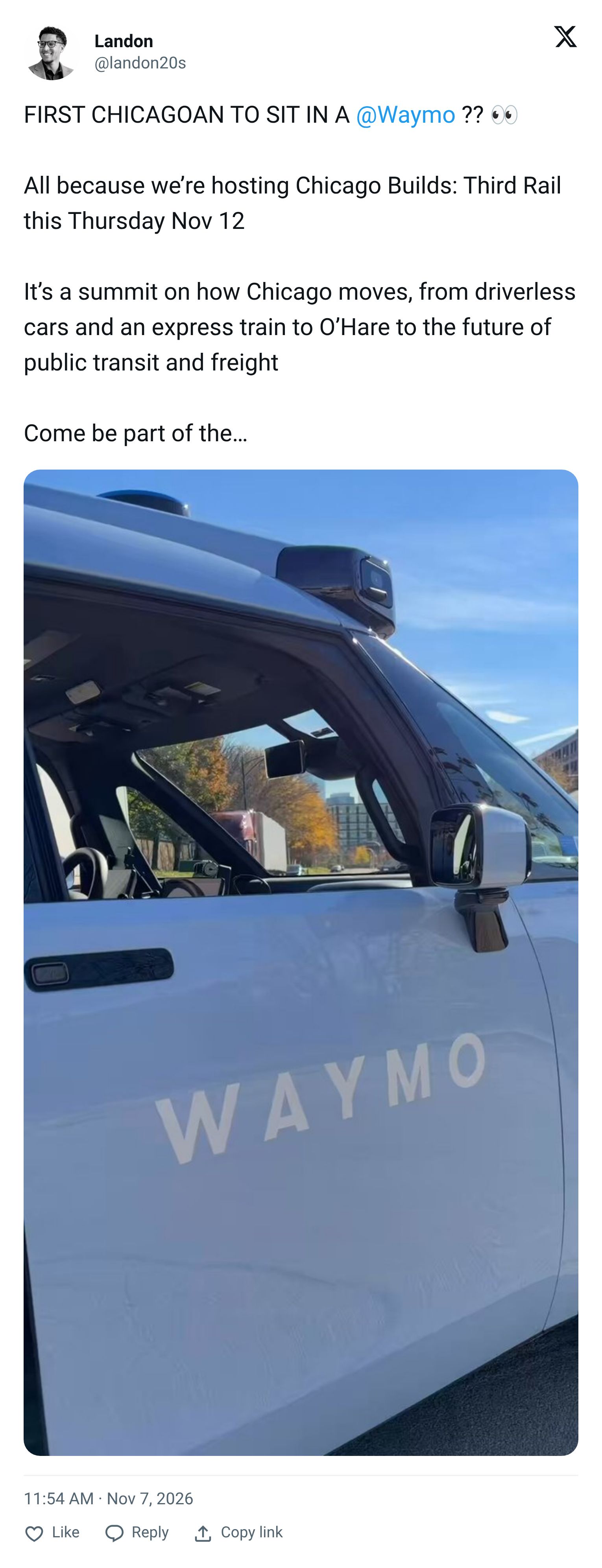
We're full. If you want in, join the waitlist and we'll let you know if a spot opens: Register here
💻 SuperCompute comes to Chicago
The global supercomputing conference is in Chicago for the first time. SC26 runs Nov 15 to 20 at McCormick Place, and we’re kicking it off with a weekend Hackathon and reception.


One of our event partners at Norton Rose Fulbright sees the conversation shifting. Chips get the headlines, but the harder question is what it takes to stand them up.
Power
Site selection used to start with fiber. That's flipped. The first question now is whether you can lock down enough power, including on-site generation and other options as the grid gets tighter. Power itself is not really the shortage. Getting it to the site is.
People
The other constraint is people. Demand is outrunning the specialized talent that can actually deliver these projects. A large construction site without that coordination is an airport without air traffic control. Coordination is now a technology problem, not just a staffing one.
Capital and risk
Projects are getting bigger, which means the financing and the insurance have to keep up. A useful rule: AI should be a source of upside, but it shouldn't underpin your underwriting case. Major data center campuses often need multiple insurers working together, so deal with insurability early, not after the concrete is poured.
Partnerships
Two filters keep showing up when people look at sites: grid access and community support. Power and capital are not enough if the neighbors and the interconnection queue are not with you.
If you want the longer versions, Sameer Ghaznavi, Norton Rose Fulbright's Chicago Partner-in-Charge, has been talking with operators, investors, engineers, and insurers on Uptime Now, the firm's data center podcast.
You can also connect with NRF’s Director of Market Expansion based in Chicago, George Khalife
📅 Who’s Hosting This Week in Chicago
What Energy Needs Next: Opportunities in Energy Transition
Monday
Entrepreneurship Essentials: Customer Discovery for Startups
Tuesday
Digital Delivery Chicago
Tuesday
Chicago Builds: Third Rail
Thursday
1871 FinTech Innovation Summit
Thursday
From Cultura to Capital
Thursday
CIQ Supercomputing Local AI Hackathon
Friday
Hosted by Drive Capital
CIQ and Drive Capital Present: Pre-SC26 Happy Hour
Sunday
Hosted by Drive Capital