

✍🏽 Landon’s Loop #181

🎙️ Chicago Futurist: Brad Tietz, Data Center Coalition

There are currently 39 data centers in Chicago.
A new report from the Illinois Economic Policy Institute and the University of Illinois said that $57B in new data center capacity could be coming to Illinois by 2035.
Brad Tietz helped pass the Illinois data center incentive in 2019. Now he represents the industry across the Midwest for the Data Center Coalition.
I sat down with him and asked the questions we keep hearing about water, jobs, and bills in relation to the data center industry, along with the state of Chicago’s unique compute market.
How should we think about data centers and water usage?
BT: In Virginia, the data center capital of the world, 83% of data centers there use as much or less water than a traditional office building. In Elk Grove Village, twenty-plus data centers there, the village put out a report that the data centers there are using less water than car washes or laundromats.
There are data centers in Illinois, because of the colder climate for much of the year, who will leverage the outdoor air for about eighty, ninety percent of the year, and then maybe turn to a liquid or water cooling solution for a few weeks during the summer. I think being transparent with water use, so people actually know how much water we are using, is incumbent upon us as an industry.
We often see reports of data centers creating no more than 20 permanent jobs, does this tell the full story on job creation?
BT: There's the on-site jobs, and that's typically for the permanent jobs, and we're often criticized for that. When you look at some of the hyperscaler facilities happening across the Midwest now, they're employing five hundred, six hundred, seven hundred and fifty people permanently. And then you get to construction, and you're looking at anywhere from a thousand to four thousand construction jobs that are often on site far longer than just a temporary job.
I don't know in what field these days five to seven years of work is kind of considered temporary.
Are data centers are the sole reason why electricity bills are rising?
BT: PJM has had a real hard time adding new generation for the last ten to fifteen years. The grid is very old, and we have not invested in it sufficiently. So we actually view ourselves as partners in modernizing the grid. Moving forward, we need to do all we can, through things like large load tariffs at the utility level, transmission security agreements, dedicated riders, whatever it is, to ensure that we in the industry are paying for our full cost of service.
In 2019 it was very difficult to see just how quickly this AI age would evolve. What would you have had different in the bill in regard to hyperscalers?
BT: You can put in there stronger clean energy requirements. You could put in there things around water reuse, reclaimed water, captured water, and opportunities to encourage career pathways. In hindsight, we could have been a little more focused on where the industry was going. I don't think we fully appreciated the power usage considerations that were going to start evolving.
Subscribe to my YouTube for conversations with leaders reshaping Chicago

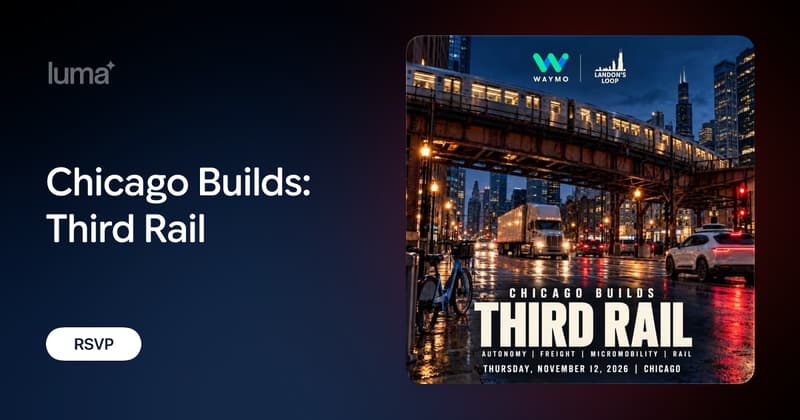
🚆 Chicago Builds: Third Rail

On Thursday, November 12, I'm hosting Chicago Builds: Third Rail. It's a summit on how people and goods move through this city: autonomy, freight, micromobility, and rail. Doors open at 2pm.
It's invite-only and application-based, with about 250 founders, operators, engineers, public officials, labor leaders, and investors.
📅 Who’s Hosting This Week in Chicago
Manufacturing Partner Day
Monday
Databricks October Meetup
Tuesday
AI Collective Chicago - Fall Demo Night 🍂
Tuesday
Reinventing Industry: Future of Health
Wednesday
Innovation on Tap
Wednesday
1871 Events: Supply Chain Innovation Summit 2026
Thursday
Chicago Code And Coffee
Sunday


